Flashcards vs Notes for Exam Revision: A Combined Approach
Nov 02, 2026 · 10 min read · The Quizard Team
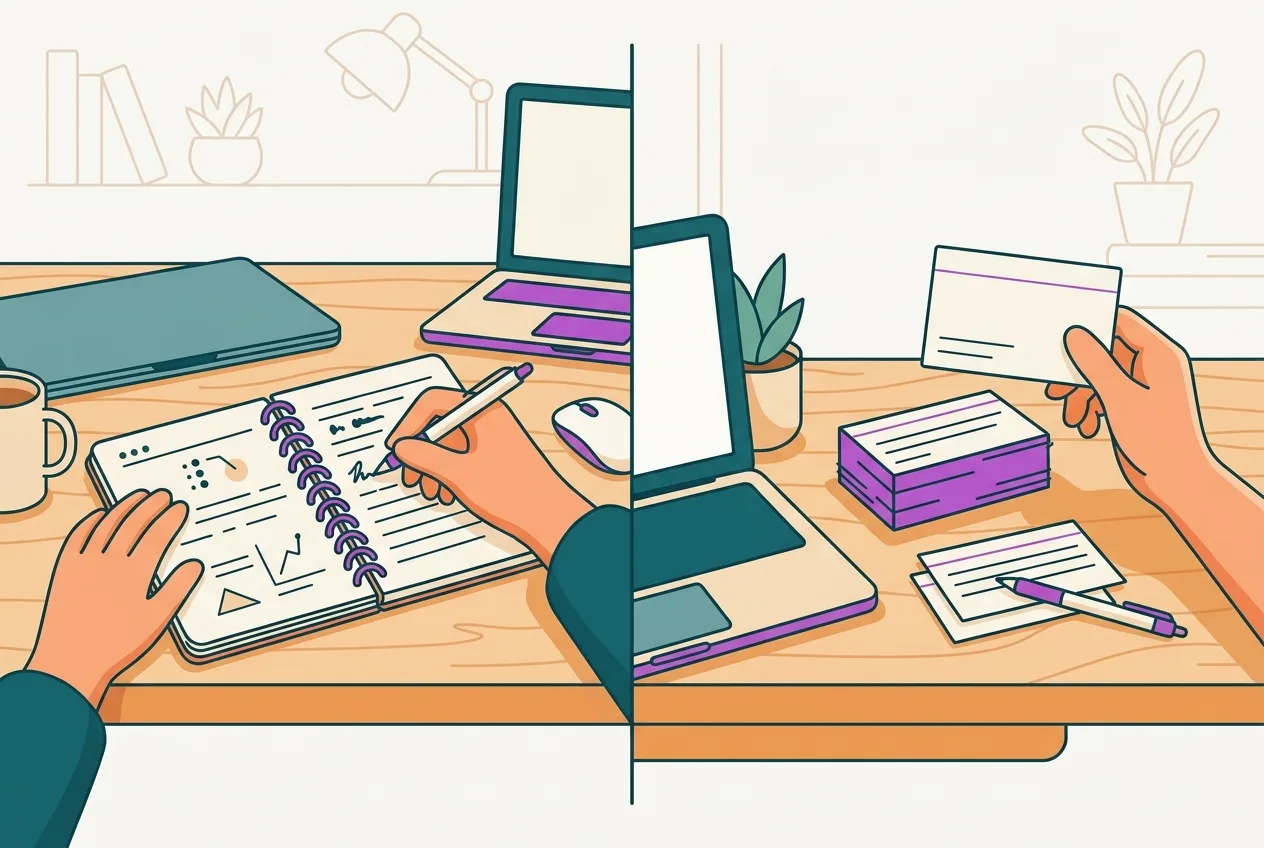
For effective exam revision, understanding when to use flashcards versus traditional notes, and how to combine them, is key. Flashcards excel at active recall of specific facts and concepts, while notes are essential for initial comprehension, contextual understanding, and connecting broader ideas. The most effective study strategy often integrates both methods to leverage their individual strengths.
The Core Purpose of Traditional Notes
Traditional notes, whether handwritten or digital, serve as your primary record for processing new information from lectures, textbooks, and readings. Their main purpose is to help you build a comprehensive understanding of a subject.
When you take notes, you are actively engaging with the material:
- Initial Learning: Notes help you capture and organize information as you encounter it, aiding in initial comprehension.
- Contextual Understanding: They allow you to see the "big picture," connecting different concepts, theories, and examples within a broader framework.
- Deep Processing: The act of summarizing, paraphrasing, and structuring information in your own words helps solidify understanding.
- Reference Point: Your notes become a personalized textbook, providing detailed explanations and a linear flow of information that can be revisited for clarity.
Common note-taking methods, such as the Cornell method, outlining, or mind mapping, are designed to facilitate this deeper level of engagement and organization. However, the drawback of relying solely on notes for revision is that passive re-reading can create a false sense of familiarity, leading to recognition without true recall.
The Power of Flashcards and Active Recall
Flashcards are specifically designed for testing and reinforcing discrete pieces of information. They are highly effective for mastering facts, definitions, formulas, dates, vocabulary, and step-by-step processes. The power of flashcards lies in two core principles:
- Active Recall: Each time you attempt to answer a flashcard, you are actively retrieving information from memory rather than passively re-reading it. This effortful retrieval strengthens neural pathways and improves long-term retention. Regularly practicing active recall is a powerful study technique. You can learn more about its benefits in our guide on active recall for exams.
- Spaced Repetition: Flashcards are ideal for implementing spaced repetition, a learning technique where you review material at increasing intervals over time. This method capitalizes on the brain's natural forgetting curve, scheduling reviews just as you are about to forget information, thus optimizing retention with minimal effort. Digital flashcard apps often automate this scheduling. For a structured approach, consider adopting a spaced repetition schedule.
Flashcards are efficient for identifying specific knowledge gaps quickly. If you consistently miss a particular card, it highlights an area that needs more attention. Their portability also allows for quick review sessions anytime, anywhere.
The main limitation of flashcards alone is that they can sometimes present information in isolated chunks, potentially fragmenting your understanding if not connected back to the broader context provided by your notes.
When to Use Notes in Your Study Routine
Notes are best utilized during the initial stages of learning and for gaining a holistic understanding:
- During Lectures or Readings: This is the primary time to take comprehensive notes, capturing new information and making initial connections.
- For Conceptual Understanding: Use notes to grasp complex theories, understand processes, or follow arguments. They help you build the narrative and context around individual facts.
- Summarizing Broad Topics: Before diving into details, use your notes to review entire chapters or lecture units to ensure you understand how all the sub-topics fit together.
- Essay Planning and Structuring: For subjects requiring analytical or essay-based answers, notes help you structure arguments, outline key points, and connect evidence.
- As a Reference: Your notes serve as a detailed resource when a flashcard answer isn't enough, providing the depth needed to clarify misunderstandings. For tips on organizing your study materials, see our guide on the best way to organize university notes for effective study.
When to Use Flashcards in Your Study Routine
Flashcards are most effective when you need to commit specific details to memory and test your recall:
- Memorizing Facts: Use flashcards for definitions, vocabulary, historical dates, scientific formulas, names, and key terms.
- Self-Testing: Flashcards provide immediate feedback on what you know and what you don't. This active self-assessment is crucial for identifying weak areas.
- Regular, Short Review Sessions: Incorporate flashcard practice into daily study blocks. Short, frequent sessions are more effective for long-term retention than infrequent, long cramming sessions.
- Consolidating Information: Once you've understood a concept from your notes, extract the core, recallable information and turn it into flashcards.
- Bridging Knowledge Gaps: After reviewing a topic with your notes, use flashcards to solidify the specific details you need to recall under pressure.
Integrating Notes and Flashcards for Comprehensive Study
The most effective revision strategy combines the strengths of both notes and flashcards. This approach ensures you build a deep understanding while simultaneously mastering the specific facts required for exams.
Here’s a step-by-step approach to integrate them:
- Understand with Notes: Begin by taking thorough notes on new material. Focus on comprehending the concepts, connections, and overall structure of the information. Do not worry about memorization at this stage; aim for clarity and completeness.
- Process and Condense: After initial note-taking, review and refine your notes. Summarize key sections, highlight critical definitions, and identify the most important facts, theories, and processes. This distillation prepares the material for flashcard creation.
- Create Targeted Flashcards: From your condensed notes, create flashcards for every piece of information that requires direct recall. Each flashcard should ideally have one clear question or prompt and one concise answer. This ensures you're testing specific knowledge rather than broad concepts.
- Practice with Active Recall and Spaced Repetition: Use your flashcards regularly. Engage in active recall, trying to answer each card before flipping it. Employ a spaced repetition schedule to optimize when you review each card, revisiting difficult ones more frequently.
- Revisit Notes for Context and Clarity: If you consistently struggle with a particular flashcard or an entire topic during your review, return to your original notes. Your notes provide the context, examples, and detailed explanations necessary to clarify misunderstandings and reinforce the fragmented knowledge from the flashcards.
- Use a Coverage Map: As you progress, tools that show which parts of your study material you've practiced and which you haven't can be invaluable. This ensures you're applying both notes and flashcards to cover all necessary content.
By following this integrated approach, you leverage notes for comprehensive learning and context, and flashcards for efficient, robust memorization and recall.
Leveraging Digital Tools for Efficiency
Manually creating and managing notes and flashcards for an entire university course load can be time-consuming. Digital tools can significantly streamline this process, allowing you to focus more on learning and less on organization.
Digital note-taking platforms offer searchable notes, easy editing, and integration with other study materials. Digital flashcard applications automatically handle spaced repetition scheduling, making your review sessions more efficient.
Platforms like Quizard take this integration a step further by generating questions and flashcards directly from your uploaded materials, such as lecture slides, notes, or recordings. This automation saves the time you would spend manually converting notes into flashcards and ensures that your study materials are consistently linked to their original source. Quizard also provides a daily review session based on spaced repetition, and a coverage map shows which slides or topics you haven't practiced yet. This holistic approach helps bridge the gap between initial note-taking and effective, recall-based revision. You can find out more about these features on our features page. For a detailed look at how to convert lecture slides specifically into flashcards, refer to our guide on from lecture slides to flashcards: your study workflow.
Practical Workflow: From Lecture to Exam-Ready
To put this combined strategy into practice, consider the following workflow:
- Attend Lectures/Process Material: Actively engage in lectures or textbook readings by taking detailed, organized notes. Focus on understanding the information. Ask yourself "why" and "how" questions as you go.
- Consolidate and Summarize: Soon after the lecture or reading, review your notes. Condense them, highlight key concepts, and fill in any gaps while the information is still fresh. Identify all the discrete facts, definitions, and processes that will require memorization.
- Generate Recall Questions and Flashcards: From your consolidated notes, create specific active recall questions and flashcards. For example, if your notes state "The Krebs cycle produces ATP, NADH, and FADH2," a flashcard could ask, "What are the main products of the Krebs cycle?" If using a tool, upload your lecture slides or notes to generate these directly. Ensure each question links back to the relevant section of your notes or slides for easy reference.
- Implement Spaced Repetition: Integrate flashcard review into your daily study schedule. Use a digital flashcard system to manage spaced repetition, ensuring you review information at optimal intervals.
- Contextual Review with Notes: Periodically, step back from individual flashcards and revisit your comprehensive notes. Review entire topics to reinforce the connections between facts and ensure you maintain a strong grasp of the broader context. Use your notes to answer any "big picture" questions that arise during flashcard practice.
- Practice Application: Beyond pure recall, use practice questions and past papers to apply the knowledge you've gained. This tests not just what you remember, but how you can use it in an exam context.
By integrating both notes and flashcards into a structured study workflow, you develop both a deep understanding of your subject matter and the ability to recall specific information under exam conditions. This balanced approach sets you up for comprehensive and lasting learning.
FAQ
Should I rewrite my notes into flashcards?
You don't need to rewrite all your notes. Instead, identify the specific facts, definitions, formulas, and key concepts within your comprehensive notes that require active recall. Convert these precise pieces of information into concise flashcards, while your original notes provide the essential context and detailed explanations.
How many flashcards should I make per lecture?
There is no fixed number, as quality is more important than quantity. Aim for 10-20 high-quality flashcards per hour of lecture or per chapter. Focus on creating cards for the most critical, recallable information rather than every minor detail, ensuring each card tests a single, clear piece of knowledge.
Can I use flashcards for complex topics like essays?
Flashcards are less effective for directly practicing complex synthesis or essay writing. However, they are highly useful for mastering the foundational facts, definitions, arguments, and evidence you will then combine and apply in an essay. Use your comprehensive notes to structure your arguments and see how concepts connect for essay planning.
Is it faster to use notes or flashcards for revision?
Initially creating notes may seem faster, but for effective long-term recall and retention, flashcards combined with active recall and spaced repetition are significantly more efficient. Notes are for initial understanding and building context, while flashcards are for rapidly testing and reinforcing specific knowledge for durable memorization.
To explore a system that helps you integrate your notes with active recall flashcards and questions, visit Quizard.
Quizard turns your own lecture slides into questions that cite the slide.
Start free