Effective Flashcards for Pharmacology Exams
Oct 31, 2026 · 10 min read · The Quizard Team
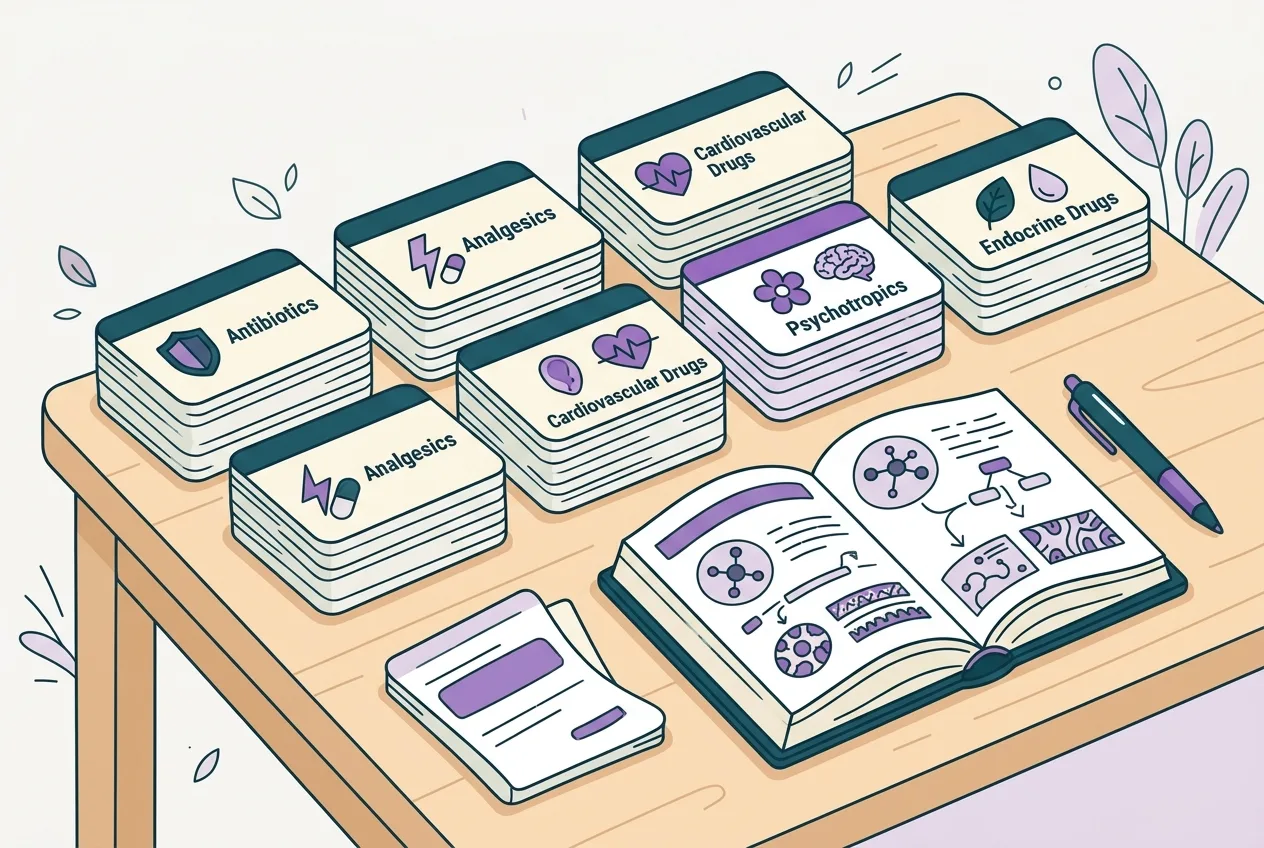
Flashcards are a highly effective tool for mastering the extensive and detailed information required for pharmacology exams. They leverage active recall and spaced repetition to help you commit drug names, mechanisms of action, side effects, and clinical uses to long-term memory.
Pharmacology requires understanding a vast amount of specific information for each drug and drug class. Simply reading notes or textbooks is often insufficient for deep learning and retention. Flashcards provide a structured way to test yourself regularly, identify knowledge gaps, and reinforce learned material.
The Unique Challenge of Pharmacology Exams
Pharmacology is known for its sheer volume of information. You need to remember:
- Drug Names: Generic and sometimes brand names.
- Drug Classes: How drugs are grouped based on structure or action.
- Mechanisms of Action (MOA): How each drug produces its effect at a molecular or cellular level.
- Indications: The conditions or diseases a drug is used to treat.
- Contraindications: Situations where a drug should not be used.
- Adverse Effects (Side Effects): Common and severe undesirable reactions.
- Drug Interactions: How drugs affect each other.
- Pharmacokinetics: Absorption, distribution, metabolism, excretion (ADME).
- Pharmacodynamics: The effects of drugs on the body.
This density of detail makes rote memorization difficult and ineffective on its own. Flashcards help break down this information into manageable, testable chunks, promoting understanding through repeated, focused engagement.
What Makes a Pharmacology Flashcard Effective?
An effective pharmacology flashcard focuses on specific, testable facts and concepts. Each card should present a question or prompt on one side and a concise, accurate answer on the other.
Here’s what to include and how to structure your cards:
Essential Information to Include
For each drug, consider creating multiple cards or structuring a single card with distinct prompts:
- Drug Name (Generic & Brand): Front: "Generic name:" Back: "Brand name:". Or Front: "Brand name:" Back: "Generic name:".
- Drug Class: Front: "Drug Name X belongs to what class?" Back: "Class Y."
- Mechanism of Action: Front: "How does Drug X work?" Back: "Explanation of MOA." Keep this concise but accurate.
- Key Indications: Front: "What are the primary uses of Drug X?" Back: "List of indications."
- Major Side Effects/Adverse Reactions: Front: "What are the significant side effects of Drug X?" Back: "List of common and serious side effects."
- Contraindications/Precautions: Front: "When should Drug X NOT be used?" Back: "List of contraindications/precautions."
- Important Drug Interactions: Front: "Which drugs interact significantly with Drug X?" Back: "List of interactions and their effects."
- Unique Characteristics/Patient Education: Front: "What is unique about Drug X (e.g., black box warning, special administration)?" Back: "Relevant details."
Formatting for Clarity and Recall
- One concept per card: Avoid overloading a single flashcard with too much information. This makes active recall more targeted. If a drug has five indications, you might have one card for all five, or a card for the drug name, and then separate cards for "Indication 1 for Drug X?".
- Question/Answer format: Frame the front as a question or prompt that requires you to recall information, rather than just stating a fact.
- Concise answers: Keep answers on the back brief and to the point. Use bullet points or short phrases.
- Use mnemonics or visual cues: If you have developed a mnemonic for a side effect, write it on the card.
- Connect to context: If a concept was explained with a specific clinical scenario in your lecture, briefly note that on the card to aid recall.
Strategies for Creating Pharmacology Flashcards
You can create flashcards manually or leverage digital tools. The process of creation itself is a form of active learning, so don't skip it entirely.
Manual Creation
When creating cards by hand, focus on active summarization:
- Identify key information: As you review your lecture slides or notes, highlight or make a list of the most important, testable facts for each drug.
- Formulate questions: For each piece of information, turn it into a question. For example, if your notes say "Metformin: decreases hepatic glucose production," your card front could be "What is a primary mechanism of action for Metformin?"
- Write concise answers: On the back, write "Decreases hepatic glucose production."
- Categorize: You might use different colored cards for different drug classes or create separate decks.
Leveraging AI Tools for Efficiency
Creating hundreds of detailed flashcards for pharmacology can be time-consuming. Digital tools, especially those with AI capabilities, can significantly streamline this process.
Quizard, for example, allows you to upload your lecture slides, notes, or recordings. Its AI can then generate exam-style questions and flashcards directly from your material. This can create a significant head start, freeing you to focus on deeper understanding and complex problem-solving. Each generated flashcard also links back to the specific slide it came from, providing context for review. For more on this workflow, see our guide on from lecture slides to flashcards: your study workflow.
Mastering Pharmacology with Spaced Repetition
Creating flashcards is only half the battle; using them effectively is crucial. The most powerful way to use flashcards is through spaced repetition. This technique optimizes learning by scheduling reviews at increasing intervals, ensuring you revisit material just before you're likely to forget it.
How Spaced Repetition Works
When you review a flashcard and recall the answer correctly, the system schedules it for a longer interval before your next review. If you forget or struggle with a card, it's scheduled for review much sooner. This intelligent scheduling focuses your study time on the information you find most challenging, while not neglecting what you already know.
Integrating Spaced Repetition into Your Study Routine
- Daily, short sessions: Instead of cramming, commit to 15-30 minute flashcard review sessions daily. Consistency is key for long-term retention.
- Review all cards regularly: Don't just focus on new material. Spaced repetition systems will ensure older material is revisited.
- Be honest with yourself: When you review a card, if you can't recall the answer quickly and accurately, mark it as "wrong" or "hard" so it gets reviewed sooner.
- Focus on understanding: While flashcards help with recall, always connect the information to broader physiological concepts and clinical relevance. Don't just memorize isolated facts.
Quizard's daily study sessions are built around spaced repetition. They automatically schedule flashcard reviews for you, presenting cards based on your performance and optimizing the review intervals. This system ensures that the vast amount of pharmacology information is systematically ingrained into your memory. You can also export your flashcards to Anki or CSV if you prefer to use other platforms for review.
Advanced Flashcard Techniques for Deeper Understanding
Beyond simple recall, you can design flashcards to promote a deeper understanding of pharmacology.
Comparison Cards
Many drugs within the same class have similar actions but differ in specific ways (e.g., potency, duration, specific side effects, routes of administration). Create cards that force you to compare and contrast:
- Front: "Compare and contrast Drug A and Drug B (e.g., MOA, half-life, common side effects)."
- Back: A concise table or bulleted list highlighting similarities and differences.
Clinical Scenario Cards
Pharmacology exams often include clinical vignettes. Create flashcards that mimic these:
- Front: "A patient presents with [symptoms]. Which drug from Class X would be most appropriate, and why?"
- Back: "Drug Y. Rationale based on MOA, indications, contraindications."
Pathophysiology Linkage Cards
Drugs intervene in disease processes. Connect the drug's action to the underlying pathophysiology.
- Front: "How does Drug X modify the pathophysiology of Condition Z?"
- Back: "Explanation of how the drug targets specific mechanisms of the disease."
These types of cards encourage critical thinking and application of knowledge, which is essential for success in pharmacology. They also align with the principles of active recall for exams, which significantly boosts learning.
Integrating Flashcards into Your Pharmacology Study Workflow
Flashcards should not be a standalone study method but part of a comprehensive strategy.
- Attend lectures and take notes: Focus on understanding the core concepts first. Refer to our guide on how to take notes from lecture slides effectively.
- Convert notes to flashcards: Immediately after a lecture or study session, create flashcards for new concepts and drugs. This reinforces learning while the information is fresh.
- Regular review: Use your flashcards daily. Don't wait until exam week. Consistent engagement with the material is more effective than cramming.
- Practice questions: Supplement flashcard review with practice questions and case studies. This helps you apply your knowledge in different contexts. Quizard can also generate exam-style questions from your notes, providing another layer of active testing.
- Utilize a coverage map: If your study tool offers one, use a coverage map (like Quizard's) to see which slides or topics you haven't yet created flashcards for, or which haven't been adequately practiced. This ensures comprehensive coverage of your course material.
- Revisit difficult concepts: When you consistently struggle with a flashcard, refer back to your lecture slides, textbook, or other resources for a deeper explanation. Don't just try to re-memorize the answer.
By integrating flashcards purposefully into your routine, you can build a strong foundation in pharmacology, preparing you not just for exams but for future clinical practice.
FAQ
How many flashcards should I create per drug?
The number of flashcards per drug depends on its complexity and the level of detail required for your exam. For simple drugs, one comprehensive card might suffice. For complex drugs with multiple MOAs, indications, and significant side effects, you might need several cards, each focusing on a specific aspect like MOA, main indications, or critical side effects. Focus on clarity and testability.
Is it better to make my own flashcards or use pre-made decks?
Creating your own flashcards is generally more effective because the act of summarizing and formulating questions is a powerful learning experience. However, pre-made decks can be a good starting point or supplement, especially for high-volume topics like pharmacology. If you use pre-made decks, review them critically and modify them to align with your course content. Tools like Quizard can generate custom flashcards directly from your lecture materials, combining efficiency with relevance.
How often should I review my pharmacology flashcards?
For optimal retention, review your flashcards daily or several times a week, following a spaced repetition schedule. This ensures that you revisit challenging information at ideal intervals, preventing forgetting and reinforcing long-term memory. Short, consistent daily sessions (e.g., 15-30 minutes) are more effective than infrequent, long cramming sessions.
What if I get a flashcard wrong repeatedly?
If you repeatedly get a flashcard wrong, it indicates a gap in your understanding, not just a failure to memorize. Go back to your original lecture slides, textbook, or other resources to re-learn the concept. Try to rephrase the question or answer on the card, or create a new card breaking down the difficult concept into smaller pieces. Do not simply try to brute-force memorize the answer without understanding.
Mastering pharmacology is a significant undertaking, but with a structured approach to flashcards and consistent practice, you can build a strong knowledge base. Explore how Quizard can streamline your pharmacology exam preparation by transforming your lecture materials into effective flashcards and practice questions.
Quizard turns your own lecture slides into questions that cite the slide.
Start free