

Active Recall for Exams: Your Complete Study Technique Guide
Oct 14, 2026 · 14 min read · The Quizard Team
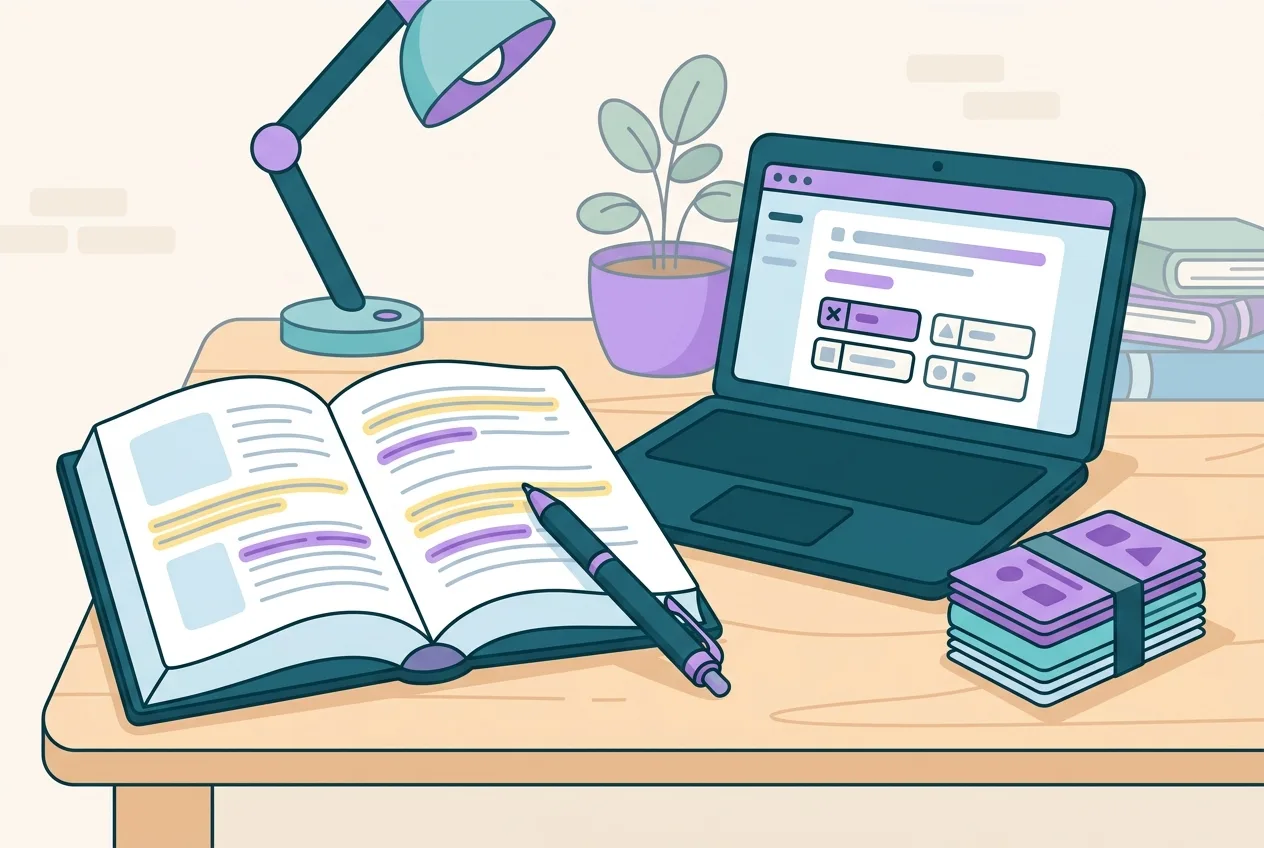
Active recall is a study technique where you deliberately retrieve information from your memory rather than passively re-reading or reviewing notes. For exams, this means testing yourself frequently on what you've learned to strengthen your understanding and retention.
This method directly addresses a common pitfall in studying: mistaking familiarity with actual knowledge. When you re-read your notes, the information feels familiar, giving a false sense of security. Active recall forces your brain to work, bringing information to the forefront and identifying what you genuinely know and what you need to revisit. It’s an effective way to prepare for university exams because it mirrors the act of taking an exam: recalling information under pressure.
What is Active Recall?
At its core, active recall is any method that requires you to retrieve information from your memory. Instead of simply looking at a definition or concept, you attempt to state it, explain it, or apply it without external aids first. This could involve:
- Self-quizzing: Asking yourself questions about the material.
- Flashcards: Using flashcards where you recall the answer before flipping.
- Summarization: Explaining a topic or chapter in your own words, out loud or written, without looking at your notes.
- Practice problems: Solving problems and then checking your answers.
The power of active recall comes from the "testing effect," a well-established principle in cognitive psychology. Research indicates that the act of retrieving information from memory significantly enhances long-term retention more than simply re-studying it. Each successful retrieval strengthens the memory trace, making it easier to access that information again in the future. Moreover, the effort involved in trying to recall helps you understand the material more deeply, rather than just memorizing surface-level facts. This makes active recall a fundamental strategy for deep learning and exam readiness.
How Active Recall Strengthens Learning
Active recall works by challenging your brain to retrieve information, which is a more demanding cognitive process than merely recognizing it. This effortful retrieval strengthens the neural pathways associated with that information, making it more robust and accessible for future recall. When you successfully recall a piece of information, you're not just confirming that you know it; you're actively reinforcing that knowledge.
Beyond strengthening memory, active recall offers several other benefits:
- Identifies knowledge gaps: When you struggle to recall something, it immediately highlights an area where your understanding is weak. This allows you to focus your study time more efficiently on what you don't know, rather than wasting time on what you already grasp.
- Enhances understanding: The process of explaining concepts in your own words or answering questions about them forces you to process the information more deeply than passive reading. This often leads to a more coherent and integrated understanding of the material.
- Improves transfer of knowledge: Because active recall simulates the conditions of an exam, it helps you practice applying what you've learned. This means you're not just memorizing facts, but learning how to use them to answer questions or solve problems.
- Boosts metacognition: Regular self-testing helps you become more aware of your own learning process. You learn to accurately assess what you know and don't know, which is a crucial skill for effective self-regulated learning. This self-awareness allows you to adjust your study strategies as needed.
The effectiveness of quizzes as a learning tool is well-documented, showing that the act of testing oneself is a powerful way to consolidate knowledge. For more on this, you can read about why quizzes are the ultimate learning tool.
Practicing Active Recall with Lecture Slides
Lecture slides are often a primary source of information for university courses. Using them effectively with active recall involves more than just reading through them.
Here's how to integrate active recall into your slide-based study:
- Transform headings into questions: After going through a set of slides, revisit the main headings or key bullet points. Instead of just reading them, turn each one into a question. For example, if a slide heading is "The Krebs Cycle Steps," ask yourself, "What are the steps of the Krebs Cycle?" or "Describe the input and output of each step of the Krebs Cycle."
- Summarize without notes: After completing a section or a full lecture's slides, close them and try to summarize the key concepts, definitions, and processes in your own words. You can do this by speaking aloud, writing a short paragraph, or even drawing a diagram from memory. Then, compare your summary to the slides to check for accuracy and completeness.
- Create flashcards: For specific terms, definitions, formulas, or short concepts, create flashcards. Write the term or question on one side and the answer on the other. When reviewing, look at the term/question and try to recall the answer before flipping the card. This process is a direct application of active recall. For detailed guidance, explore the science of flashcards.
- Use the "blurting" method: After studying a particular slide or concept, take a blank piece of paper and write down everything you can remember about it without looking at your notes. This is a form of free recall that helps consolidate information. Once you've written everything you can, compare it to your slides to identify gaps.
- Leverage AI question generation: Tools like Quizard can automatically generate exam-style questions and flashcards directly from your uploaded lecture slides, linking each question back to its source slide. This saves time in creating your own questions and ensures comprehensive coverage of the material presented in your lectures. You can then use these generated questions for self-quizzing. Quizard also provides a coverage map to show which slides have not yet been practiced, helping you ensure that you don't overlook any material.
Applying Active Recall to Past Papers
Past papers are invaluable resources for exam preparation, and they become even more powerful when used with active recall. Don't just complete them; use them to diagnose and address your learning gaps.
Here's a systematic approach:
- Attempt papers under exam conditions: Treat past papers as actual exams. Set a timer, work in a quiet environment, and do not refer to notes. This provides an accurate assessment of your current knowledge and time management skills.
- Mark and analyze thoroughly: Once completed, mark your paper using the provided solutions or mark schemes. Don't just note the score. For every incorrect answer or question where you struggled:
- Identify the specific topic: Pinpoint the exact concept, formula, or theory you failed to recall or apply correctly.
- Understand the mistake: Was it a factual error, a misunderstanding of the question, a calculation mistake, or a conceptual gap?
- Turn mistakes into active recall questions: For each area where you made a mistake, create a new active recall question. For example, if you incorrectly answered a question about "mitosis," your new question might be "Describe the stages of mitosis and their key events" or "What are the differences between mitosis and meiosis?"
- Revisit and re-quiz: Go back to your lecture slides, textbook, or notes to review the specific topic related to your mistake. Once you feel you understand it, immediately test yourself using the new active recall question you created. Do not move on until you can confidently answer it without assistance.
- Track challenging areas: Keep a running list of topics you consistently struggle with in past papers. These are your high-priority areas for continuous active recall and spaced repetition.
Using past papers in this way transforms them from mere practice tests into powerful learning tools. They don't just tell you what you got wrong; they guide you on how to fix those gaps in your knowledge through targeted active recall.
Common Mistakes to Avoid
While active recall is a powerful technique, certain practices can reduce its effectiveness. Be aware of these common mistakes:
- Passive review mistaken for active recall: This is the most prevalent error. Simply re-reading notes or flipping through flashcards without attempting to retrieve the answer first is not active recall. If you don't engage in the mental effort of retrieval, you're not reaping the benefits. Always cover the answer and try to recall before revealing it.
- Creating overly broad or vague questions: Questions like "Tell me about Chapter 3" are too general. Effective active recall questions are specific, targeting key concepts, definitions, processes, or relationships. Instead, ask "Explain the relationship between supply and demand elasticity" or "List the main causes and effects of X."
- Not checking answers or understanding mistakes: It's crucial to verify your recall immediately after an attempt. If you make a mistake, don't just note it and move on. Understand why you were wrong, consult your notes, and correct your understanding. Without this feedback loop, you risk reinforcing incorrect information or leaving gaps unaddressed.
- Inconsistent application: Active recall is most effective when practiced regularly, not just in cramming sessions. Sporadic use limits its ability to build strong, lasting memory traces. Integrate it into your daily or weekly study routine from the start of the semester.
- Not mixing with spaced repetition: While active recall helps you retrieve information, spaced repetition dictates when you should review it. Without a spaced repetition schedule, you might review too frequently (inefficient) or too infrequently (forgetting). The two techniques are highly complementary for long-term retention.
- Focusing only on facts, not understanding: Active recall isn't just for rote memorization. Practice explaining concepts, comparing and contrasting ideas, and applying principles to new scenarios. This encourages deeper understanding and critical thinking, which are essential for complex university exams.
By avoiding these pitfalls, you can maximize the impact of active recall on your exam preparation and achieve a more profound understanding of your course material.
Integrating Active Recall with Spaced Repetition
Active recall and spaced repetition are two of the most effective study techniques, and their power is magnified when combined. While active recall focuses on how you retrieve information, spaced repetition dictates when you should retrieve it.
What is Spaced Repetition? Spaced repetition is a learning technique that involves reviewing previously learned material at increasing intervals over time. The idea is to review information just as you're about to forget it. This timing optimizes memory consolidation, ensuring that information moves from short-term to long-term memory more efficiently. Tools like Anki are built entirely around this principle.
Why Combine Them?
- Maximizes Retention: Active recall strengthens the memory trace, and spaced repetition ensures that these strengthened memories are reinforced at optimal intervals, preventing forgetting.
- Efficient Study: Spaced repetition systems often prioritize the material you find most difficult, presenting it more frequently, while less challenging material is reviewed less often. This directs your active recall efforts to where they are most needed, making your study time highly efficient.
- Long-Term Mastery: For university students, remembering information for just one exam isn't enough; you often need to build upon previous knowledge in subsequent courses. This combination helps you achieve true long-term mastery.
How to Implement the Combination:
- Create active recall prompts: As you learn new material, convert key concepts, definitions, and processes into active recall questions or flashcards.
- Use a spaced repetition system: Input your active recall prompts into a spaced repetition software (like Anki) or use a system that incorporates it, such as Quizard's daily review sessions. Quizard's daily session automatically schedules spaced-repetition reviews, ensuring you revisit material at optimal intervals.
- Engage in active recall during reviews: When a spaced repetition system prompts you to review a flashcard or question, engage in active recall. Try to retrieve the answer before revealing it. Only mark it as "easy" if you recalled it quickly and correctly; mark it as "hard" if you struggled or were wrong. This feedback loop informs the system on when to show you that item again.
By using active recall within a spaced repetition framework, you're not just reviewing; you're actively reinforcing your learning at the most effective times. This method is far more effective for long-term retention than traditional re-reading or last-minute cramming.
A Simple Weekly Active Recall Routine for Exams
Establishing a consistent routine is key to making active recall an effective part of your exam preparation. This sample weekly routine balances learning new material with reviewing old, integrating active recall throughout.
Daily Principles:
- Start with review: Begin each study session with 10-15 minutes of active recall on material from previous days.
- Integrate after new learning: Immediately apply active recall techniques (self-quizzing, summarizing) after learning a new topic.
- End with planning: At the end of each session, quickly plan what you'll focus on for active recall tomorrow.
Weekly Structure:
-
Monday & Tuesday: New Material & Initial Recall (e.g., 2-3 hours per subject)
- Attend lectures or read new textbook chapters.
- As you go through new lecture slides or readings, create active recall questions or flashcards for key concepts.
- Immediately after a topic, close your notes and attempt to summarize or explain it aloud.
- Complete any assigned practice problems, using them as active recall opportunities.
- Quizard use: Upload new slides, generate initial questions and flashcards.
-
Wednesday & Thursday: Reinforcement & Deeper Recall (e.g., 2-3 hours per subject)
- Morning review: Use active recall on material from Monday and Tuesday using your flashcards or self-generated questions.
- Focused recall: Choose a specific topic from the previous week that you found challenging and dedicate a session to actively recalling and explaining it in detail without notes.
- Work through a section of a past paper or a set of practice questions related to recent topics.
- Quizard use: Engage with the daily review session, focusing on questions from previous days. Use the coverage map to see what hasn't been practiced.
-
Friday: Broader Review & Connections (e.g., 2-3 hours per subject)
- Cumulative active recall: Review material from earlier in the course (e.g., last month) using a mix of your flashcards and self-quizzing.
- Concept mapping: Create a concept map from memory, linking different topics and subtopics covered over the past few weeks. Then compare it to your notes.
- Attempt a full section or a full past paper from a previous exam cycle. Analyze mistakes using the active recall method described earlier.
-
Saturday: Problem-Solving & Weaknesses (e.g., 3-4 hours total)
- Targeted active recall: Focus solely on the topics or questions you've identified as weak points during the week. Spend extra time explaining these concepts to yourself or a study partner.
- Work through more complex problems or essay questions, outlining your answers using active recall before looking at sample solutions.
- Quizard use: Focus on questions Quizard has marked for review due to previous difficulty.
-
Sunday: Rest & Light Review (e.g., 1 hour total)
- Take a break! Rest is crucial for memory consolidation.
- Optionally, do a very light active recall session on just a few of the most difficult concepts from the week. This is more of a mental check-in than a rigorous study session.
This routine is flexible. Adjust the timing and duration based on your course load and personal learning style. The key is consistent, deliberate retrieval practice. For a broader view on optimizing your study time, consider reading our guide on how to study smarter, not longer.
FAQ
Is active recall only for memorization?
No, active recall is effective for more than just memorizing facts. It strengthens your understanding of concepts, helps you make connections between different topics, and improves your ability to apply knowledge to new problems. When you try to explain a concept in your own words, you are testing both your recall and your comprehension.
How often should I use active recall?
You should incorporate active recall regularly into your study routine, not just before exams. It's most effective when used immediately after learning new material and then consistently through spaced repetition. Daily short sessions are often more effective than infrequent, long sessions for long-term retention.
Can I use active recall for essay-based exams?
Yes, active recall is highly beneficial for essay-based exams. Instead of re-reading model essays or notes, practice outlining answers to potential essay questions without looking at your material. Explain complex theories or arguments aloud, and try to recall evidence and examples to support your points. This trains your brain to structure arguments and retrieve information under exam conditions.
Quizard turns your own lecture slides into questions that cite the slide.
Start free