Practical Ways to Stop Procrastinating When Studying
Oct 25, 2026 · 9 min read · The Quizard Team
Procrastination is a common challenge for students, but you can overcome it with specific, practical strategies. These tactics focus on making the act of starting easier, maintaining focus, and structuring your study time effectively.
Understand Why You Procrastinate
Before you can tackle procrastination, it helps to understand its roots. Procrastination isn't usually about laziness; it's often a coping mechanism for managing negative emotions associated with a task. These emotions might include:
- Fear of failure: The pressure to perform well can be paralyzing.
- Feeling overwhelmed: A large, complex task can seem impossible to start.
- Lack of interest: You might genuinely find the subject boring or irrelevant.
- Perfectionism: Waiting until conditions are "perfect" to begin can lead to endless delays.
- Distraction: The immediate gratification of other activities (social media, entertainment) can pull you away from studying.
Recognizing these underlying reasons can help you choose the right strategy. Instead of blaming yourself, approach procrastination as a problem to solve with specific techniques.
The "Tiny Start" Method
One of the biggest hurdles to studying is simply getting started. The "tiny start" method, also known as the "five-minute rule" or "just do something small," is a powerful way to overcome this initial inertia. The idea is to commit to an extremely small, almost trivial, task related to your studying for just a few minutes.
Here's how it works:
- Identify your next study task: For example, "Write an essay for History" or "Review Chemistry Chapter 3."
- Break it down into the smallest possible first step: This step should be so easy that it feels ridiculous to procrastinate on it.
- Instead of "Write essay," your tiny start might be: "Open the blank document." "Read the first sentence of the prompt." "Find one source." "Write a single sentence related to the introduction."
- Instead of "Review Chemistry Chapter 3," it might be: "Open the textbook to Chapter 3." "Read the first heading." "Look at the first diagram." "Highlight one key term."
- Commit to doing only that small step for 2-5 minutes. Tell yourself that if you still don't feel like continuing after this tiny start, you can stop.
Often, once you've completed that initial small step, the momentum builds, and the task no longer feels as daunting. The activation energy required to start has been lowered, and you're more likely to continue. The goal is to trick your brain into overcoming the initial resistance.
Leverage Timers for Focused Work
Structured time blocks can significantly improve focus and reduce the tendency to procrastinate by creating clear boundaries for your work. Timers help you commit to a specific period of effort, knowing there's a defined end point and a break coming.
The Pomodoro Technique is a popular and effective method. It involves:
- Choosing a task.
- Setting a timer for 25 minutes (one "Pomodoro").
- Working on the task with intense focus until the timer rings. If a distraction comes to mind, jot it down to address later, but keep working.
- Taking a 5-minute short break when the timer rings. Get up, stretch, walk away from your workspace.
- After every four Pomodoros, take a longer break (15-30 minutes).
This method breaks down large study sessions into manageable chunks, preventing burnout and maintaining motivation. The short breaks provide regular opportunities to reset your focus. You can use any timer, but a dedicated Pomodoro timer can help keep track of your sessions and breaks. For more details on this technique, see our guide on The Pomodoro Technique.
Other timed methods include:
- Time Blocking: Dedicate specific blocks in your schedule for particular subjects or tasks, e.g., "Monday 9-11 AM: Biology review."
- Interval Studying: Similar to Pomodoro but with customizable work and break times (e.g., 45 minutes work, 10 minutes break). Experiment to find what works best for your attention span.
Remove Friction and Distractions
A significant contributor to procrastination is the presence of friction and distractions in your environment. Reducing these makes it easier to start and harder to stop.
Optimize Your Physical Study Space
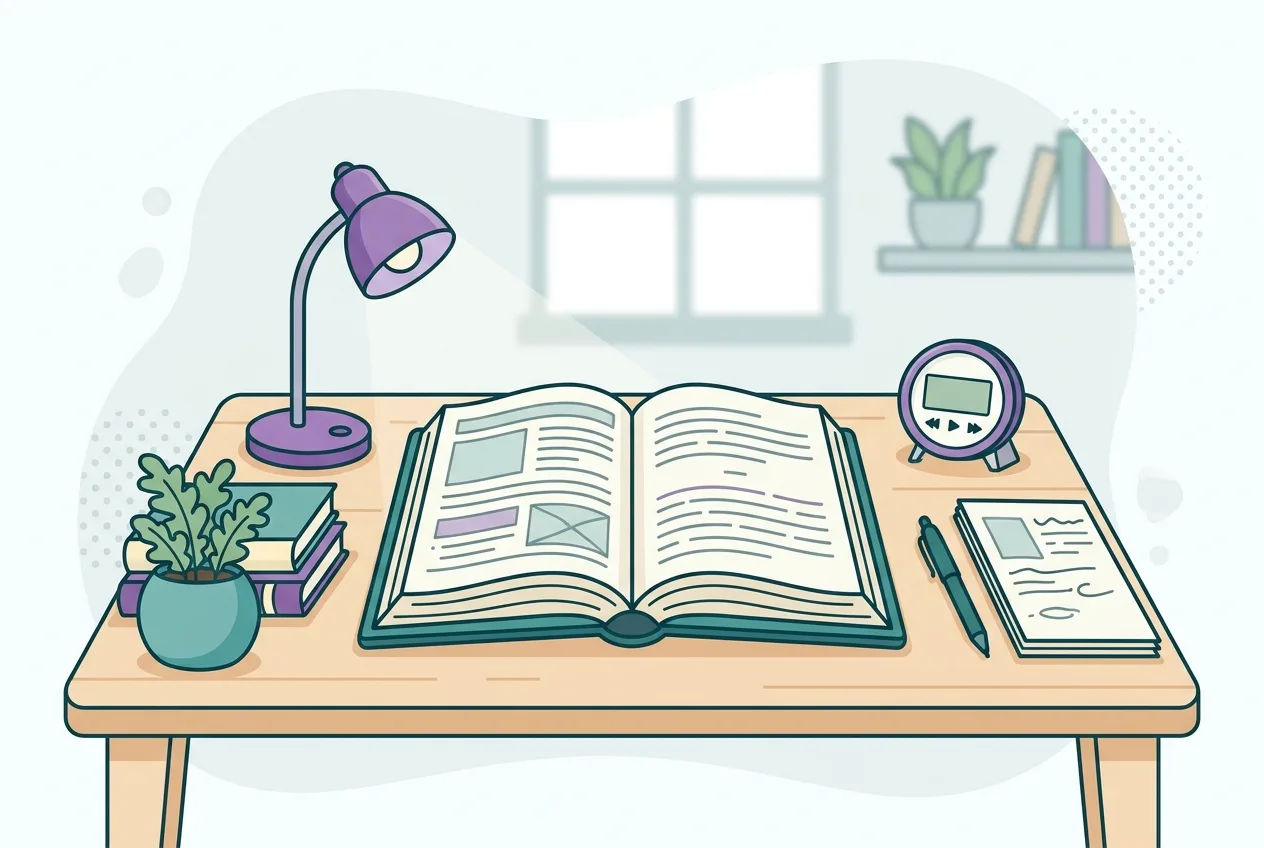
- Declutter: A clean, organized desk reduces visual distractions and makes your space feel more inviting for work.
- Minimize noise: Find a quiet spot. If complete silence isn't possible, use noise-canceling headphones or listen to instrumental music or white noise.
- Ergonomics: Ensure your chair and desk are comfortable. Discomfort can quickly become a reason to stop studying.
- Prepare materials in advance: Before you sit down to study, have everything you need within reach: textbooks, notes, pens, water bottle, a healthy snack. Avoid having to get up mid-session.
Combat Digital Distractions
Our devices are powerful tools but also major sources of procrastination.
- Phone out of sight, out of mind: Put your phone in another room or in a drawer on silent. If you need it for study tools, use airplane mode or turn off notifications.
- Website blockers: Install browser extensions that block distracting websites (social media, entertainment news) during your study times.
- Log out of social media: Manually logging out adds a small barrier, making it less likely you'll instinctively check them.
- Close unnecessary tabs: A cluttered browser can be as distracting as a cluttered desk.
- Disable notifications: Turn off non-essential notifications on your computer and phone to prevent interruptions. For more on this, read our post on How to Stop Doomscrolling While Studying.
Break Down Overwhelming Tasks
Large, ambiguous tasks are prime triggers for procrastination because they feel too big to tackle. Breaking them into smaller, more manageable steps makes them less intimidating and provides a clearer path forward.
Consider a large task like "Study for the Biology final exam." This can feel overwhelming. Instead, break it down:
- Review Lecture 1 slides and notes.
- Create 10 flashcards from Lecture 1.
- Do practice questions for Lecture 1.
- Review Lecture 2 slides and notes.
- And so on.
Each smaller step is a distinct, achievable mini-task. As you complete each one, you gain a sense of accomplishment, which fuels motivation to continue. Use a planner or a simple to-do list to track these smaller tasks.
Quizard can assist significantly here by transforming your large lecture slide decks or notes into bite-sized, actionable study components. It generates exam-style questions and flashcards directly from your uploaded materials, effectively breaking down your study content into manageable units that are easier to start and track. This feature can be a powerful antidote to feeling overwhelmed by a vast amount of material. You can learn more about how it works by exploring Quizard's features.
Reward Yourself (Sensibly)
Positive reinforcement is a strong motivator. When you complete a study session or a significant chunk of work, reward yourself. The key is that the reward should be proportionate to the effort and something you genuinely look forward to, but not something that derails your momentum or creates further distraction.
Good rewards include:
- Short, enjoyable breaks: A few minutes of stretching, listening to a favorite song, or stepping outside for fresh air.
- A small, healthy snack or drink.
- A brief check of social media or a quick message to a friend (but be strict about the time limit).
- Moving on to a more enjoyable study topic after completing a difficult one.
Avoid rewards that are too large or too far in the future, as they lose their immediate motivational power. The reward should be a direct consequence of completing the task, reinforcing the positive study habit.
Monitor Progress and Stay Accountable
Tracking your progress provides a sense of accomplishment and keeps you aware of what still needs to be done, reducing the chance of procrastination due to uncertainty.
- To-do lists: Check off items as you complete them. Seeing progress visually can be highly motivating.
- Study trackers: Use a simple notebook, spreadsheet, or app to record your study hours, topics covered, or tasks completed.
- Coverage maps: Some study tools, like Quizard, offer coverage maps that visually show you which parts of your lecture slides or notes you've already reviewed and which still need attention. This makes it clear where to focus next and prevents you from avoiding difficult topics. Learn more about how Quizard helps you cover all your material on its features page.
- Accountability partner: Share your study goals with a friend, classmate, or family member. Knowing someone else is aware of your commitments can increase your motivation to follow through. Regular check-ins can keep both of you on track.
- Create a study schedule: A well-structured schedule ensures you allocate time for all your subjects and tasks. This reduces procrastination by removing the "what should I do now?" dilemma. Our guide on how to make a study schedule for finals can provide more detailed steps.
Conclusion
Stopping procrastination when studying is a skill that improves with practice. By implementing practical strategies like starting small, using timers, eliminating distractions, breaking down large tasks, rewarding your efforts, and tracking your progress, you can build effective study habits. Be patient with yourself, celebrate small victories, and adjust your approach as you learn what works best for you.
FAQ
How long should a "tiny start" be?
A tiny start should ideally be no more than 2-5 minutes. The goal is to make the initial commitment so small that your brain has almost no reason to resist it, allowing you to bypass the mental block that often prevents starting.
How do I deal with digital distractions effectively?
To deal with digital distractions, physically remove your phone from your workspace, use website blockers for distracting sites, log out of social media accounts, and disable non-essential notifications on all devices during study sessions. These steps create friction for distractions, making focused work easier.
What if I feel overwhelmed even with small tasks?
If even small tasks feel overwhelming, try making them even smaller. For example, if "read one paragraph" is too much, try "read one sentence" or "open the textbook." Sometimes, simply setting up your study materials or defining the task is a sufficient "tiny start" to build momentum.
Quizard turns your own lecture slides into questions that cite the slide.
Start free