How to Study for Dental School Exams: Anatomy & Clinical Recall
Oct 22, 2026 · 9 min read · The Quizard Team
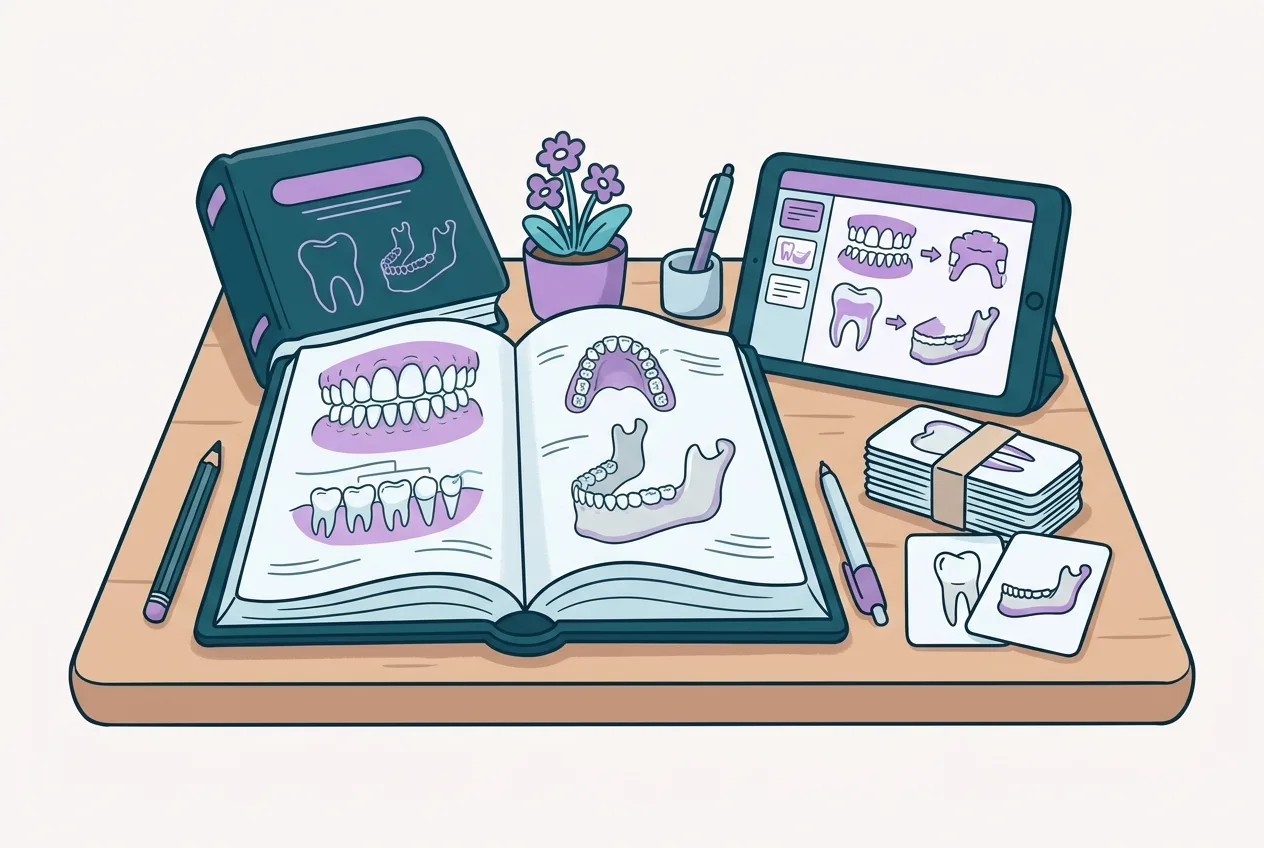
Studying for dental school exams requires a focused approach that integrates vast amounts of anatomical and clinical information with strong visual recall. Success hinges on consistently applying active recall and spaced repetition, especially for image-heavy subjects like histology and radiology, and connecting basic sciences to clinical application.
Understanding the Unique Demands of Dental Exams
Dental school curricula are dense, combining foundational basic sciences like anatomy, physiology, and biochemistry with specialized dental sciences such as oral biology, periodontology, restorative dentistry, and oral pathology. Many courses are heavily visual, relying on detailed diagrams, microscopic images, radiographic films, and clinical photographs. This means rote memorization alone is often insufficient; true understanding and retention come from recognizing patterns, structures, and their clinical implications under varying conditions. The material often builds rapidly, requiring continuous review and a deep understanding of core concepts before moving to advanced topics.
Mastering Dental Anatomy and Histology through Visual Recall
Anatomy and histology are cornerstones of dental education, demanding precise recall of structures, their locations, and functions. Given the visual nature of these subjects, effective study techniques must leverage images.
- Sketching and Labeling: Do not just look at diagrams; actively redraw and label anatomical structures like cranial nerves, muscles of mastication, or tooth morphology. For histology, sketch different tissue types (e.g., pulp, enamel, dentin) and their characteristic cells or layers. This engages multiple areas of your brain, enhancing memory.
- Using 3D Models and Cadavers: When available, spend time with anatomical models and cadaver dissections. Manipulating physical structures provides a spatial understanding that 2D images cannot fully replicate. As you interact with these models, verbally identify structures and their relationships.
- Flashcards with Images: Create flashcards where one side shows an unlabeled image (e.g., a tooth cross-section, an X-ray, a histological slide) and the other side lists the labeled parts or identifies the key features. This trains your brain for rapid visual recognition, which is crucial in both written and practical exams.
- Practice Identifying from Different Angles: Anatomical structures look different from various perspectives. Ensure your study materials include diverse images and practice identifying structures in various orientations, including radiographs, which present a unique challenge in 2D interpretation of 3D objects.
- Relate to Function and Clinical Relevance: Do not just memorize names. Understand what each anatomical structure does and why it is clinically significant. For instance, knowing the path of the inferior alveolar nerve is critical for understanding local anesthesia.
Quizard can help by generating questions and flashcards directly from your lecture slides, including those with images. This allows you to quickly create image-based active recall materials without manually transcribing every detail.
Integrating Clinical Knowledge from Day One
Dental school material quickly shifts from basic sciences to their clinical application. Successful students learn to bridge this gap early on.
- Case-Based Learning: Many dental courses use case studies to teach diagnosis and treatment planning. Actively engage with these cases. Instead of just reading the solution, try to work through them systematically:
- Identify the chief complaint and relevant patient history.
- List potential differential diagnoses.
- Determine necessary diagnostic tests (X-rays, biopsies, etc.).
- Formulate a treatment plan with rationale.
- Consider potential complications.
- Connect Basic Science to Clinical Outcomes: When studying a disease, such as periodontitis, actively link its pathophysiology (basic science) to its clinical manifestations (gingival inflammation, bone loss) and potential treatments (scaling and root planing, antibiotics). Ask "why" and "how" repeatedly. For example, "Why does this bacteria cause this specific type of tissue destruction?"
- Utilize Clinical Textbooks and Journals: Supplement lecture material with clinical textbooks and relevant journal articles. These often provide a broader perspective and more detailed clinical insights than lectures alone. Focus on understanding common conditions and evidence-based treatments.
- Shadowing and Clinic Experience: The best way to integrate clinical knowledge is through direct observation and participation. Pay close attention in clinics, ask questions, and try to connect what you see with the theoretical knowledge from your lectures.
Active Recall and Practice Questions for Dental Concepts
Active recall is one of the most effective study techniques for long-term retention, particularly with complex, interconnected information found in dental school. Instead of passively rereading notes, you actively retrieve information from memory.
- Self-Quizzing: After reviewing a topic, close your notes and try to explain it out loud or write down everything you remember. Compare your recall to your notes and identify gaps. This meta-cognition helps you pinpoint what you truly know and what needs more work.
- Transform Notes into Questions: Convert your lecture slides and notes into questions. For example, if a slide discusses "Branches of the Maxillary Artery," turn it into "List the branches of the maxillary artery" or "Identify the structures supplied by the maxillary artery." Answer these questions without looking at your notes.
- Practice Exams: If your professors provide practice exams, use them under timed, exam-like conditions. If not, create your own or find questions from textbooks or review materials. This not only tests your knowledge but also familiarizes you with the exam format and helps you manage your time.
- Collaborate and Teach: Study groups can be highly effective for active recall. Explain concepts to your peers, or have them quiz you. Teaching others forces you to organize your thoughts and identify areas where your understanding is weak.
- Image-Based Questions: For anatomy, histology, and radiology, practice with "spotter" questions where you identify structures on an unlabeled image or explain a pathological finding on a radiograph.
For a deeper dive into this technique, read our guide on Active Recall for Exams.
Spaced Repetition for Long-Term Dental Knowledge Retention
The sheer volume of information in dental school makes spaced repetition indispensable. This technique involves reviewing material at increasing intervals over time, moving information from short-term to long-term memory.
- Schedule Your Reviews: Do not wait until the night before an exam to review a topic. Implement a consistent review schedule. For example, review new material within 24 hours, then again in 3 days, 1 week, 2 weeks, and so on.
- Use Digital Flashcard Apps: Tools that incorporate spaced repetition algorithms, such as Anki, are highly effective. These apps track your performance and schedule flashcards for review precisely when you are about to forget them. You can customize flashcards to include images, diagrams, and even short clinical scenarios.
- Integrate with Your Study Routine: Make spaced repetition a daily habit. Even 15-30 minutes of flashcard review per day can significantly improve long-term retention across multiple subjects.
- Prioritize Difficult Material: Spaced repetition systems naturally prioritize material you find more difficult, showing those cards more frequently. Trust the algorithm and focus your efforts where they are most needed.
Learn more about setting up your review schedule in our Spaced Repetition Schedule for Exams: Your 4-Week Plan post.
Efficiently Using Lecture Slides and Resources
Lecture slides are often the primary source of information in dental school. Learning to extract and process this information efficiently is crucial.
- Pre-Read Before Lectures: If slides are available beforehand, skim through them to get an overview of the topic. Note any unfamiliar terms or complex diagrams. This primes your brain for the lecture and helps you focus on understanding, not just transcription.
- Annotate Actively During Lectures: Instead of trying to write down everything, use the slides as a framework. Add notes, clarify points, draw connections, and highlight key information directly on the slides or in an accompanying notebook. Focus on what the lecturer emphasizes.
- Summarize After Lectures: Shortly after the lecture, review your annotated slides and summarize the main points in your own words. This immediate review significantly boosts retention.
- Convert Slides to Study Tools: Transform key information from your slides into active recall tools. Turn headings into questions, diagrams into labeling exercises, and definitions into flashcards. Quizard can automate this process by generating questions and flashcards directly from your uploaded lecture slides, streamlining your study workflow.
For more detailed strategies on this, refer to our guide on How to Study from Lecture Slides Effectively.
Practical Strategies for Success in Dental School
Beyond specific study techniques, general habits and strategies can make a significant difference.
- Maintain a Study Schedule: Dental school is a marathon. Create a realistic weekly study schedule that allocates time for each subject, review, and breaks. Stick to it as much as possible.
- Prioritize Effectively: You cannot master everything. Understand what concepts are foundational, frequently tested, or clinically high-yield, and focus your efforts there.
- Manage Your Well-being: High-stress environments like dental school can lead to burnout. Prioritize sleep, nutrition, exercise, and social connections. Short, regular breaks are more effective than prolonged, intense study sessions without rest. Consider using a Pomodoro timer to structure your study and break periods effectively.
- Utilize Peer Support: Your classmates are going through the same challenges. Form study groups, share resources, and support each other. Explaining concepts to a peer reinforces your own learning.
- Seek Clarification: Do not hesitate to ask professors, TAs, or upper-year students for clarification on concepts you find difficult. Early intervention is key.
FAQ
How much time should I dedicate to studying for dental school exams?
The amount of study time varies per student and course, but consistent daily effort is key. Aim for several hours each day, beyond lecture time, focusing on active recall and spaced repetition. Breaking your study into manageable chunks is more effective than cramming.
What is the best way to handle the overwhelming volume of material?
Break down large topics into smaller, digestible units. Prioritize high-yield information and integrate concepts across subjects rather than studying them in isolation. Consistent use of spaced repetition and active recall tools will prevent material from accumulating.
How can I prepare for practical (pre-clinical) exams?
Practical exams require hands-on skill development. Dedicate ample time in the simulation lab, practice procedures repeatedly, and seek feedback from instructors. Understand the underlying anatomy and theory thoroughly, as practical exams often test your knowledge application.
Should I study alone or in groups for dental school?
Both individual and group study have benefits. Individual study is crucial for initial learning and self-assessment, while group study can clarify complex topics, facilitate active recall through peer teaching, and provide diverse perspectives on clinical cases. Balance both approaches.
Quizard turns your own lecture slides into questions that cite the slide.
Start free