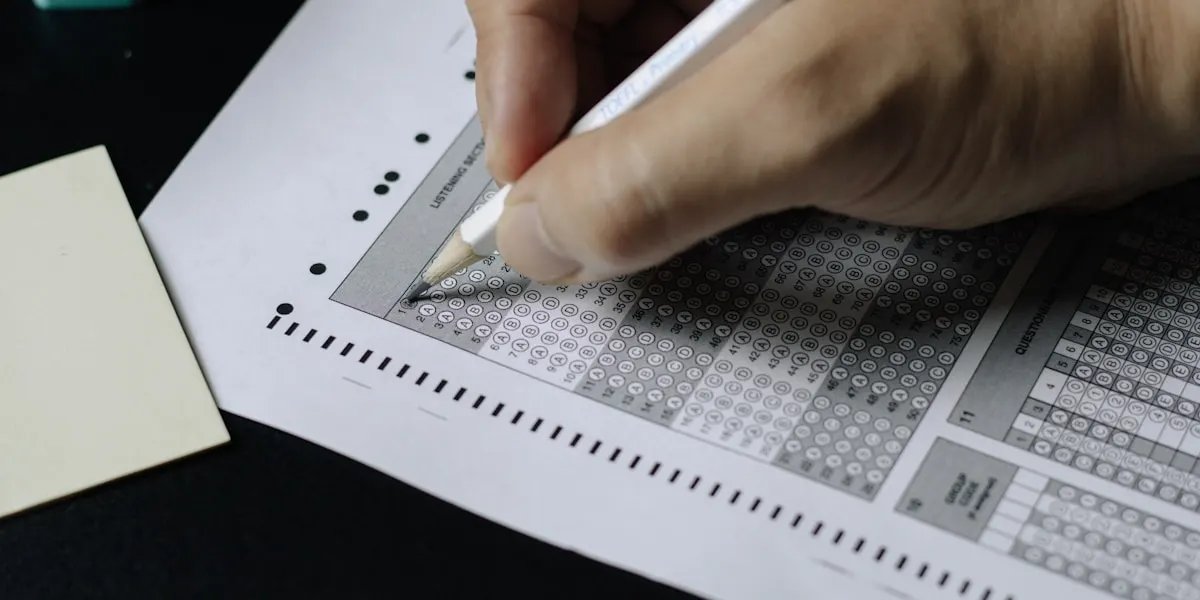
Understanding the SAT in 2026
The SAT remains one of the most important standardized tests for college admissions in the United States. With a total score range of 400-1600 (combining Evidence-Based Reading and Writing with Math), even a 100-point increase can significantly improve your college prospects and scholarship opportunities.
The current SAT format consists of:
- Reading: 52 questions in 65 minutes
- Writing and Language: 44 questions in 35 minutes
- Math (No Calculator): 20 questions in 25 minutes
- Math (Calculator): 38 questions in 55 minutes
- Optional Essay: 50 minutes (though many colleges no longer require it)
The key to SAT success isn't just knowledge—it's strategy, practice, and understanding exactly what the test makers are looking for.
The 12-Week SAT Study Plan
Weeks 1-2: Diagnostic and Planning
Start with a full-length practice test under realistic conditions. This baseline score is crucial for tracking progress and identifying weaknesses.
Action items:
- Take an official College Board practice test
- Score it honestly and identify your weak areas
- Set a realistic target score (typically 100-300 points above baseline)
- Create a study schedule with specific time blocks
- Gather your study materials
Time commitment: 10-12 hours per week
Weeks 3-6: Content Review and Skill Building
Focus on understanding concepts and building foundational skills. Don't just do practice problems—understand WHY answers are correct or incorrect.
Reading Section:
- Practice active reading techniques
- Learn to identify question types (main idea, inference, vocabulary in context, evidence-based)
- Read high-quality sources daily (The Atlantic, Scientific American, classic literature)
- Master the process of elimination strategy
- Time yourself: aim for 13 minutes per passage initially, working down to 10 minutes
Writing and Language Section:
- Review grammar rules systematically (subject-verb agreement, pronoun agreement, parallelism, modifiers)
- Understand punctuation rules (commas, semicolons, colons, dashes)
- Master transition words and sentence structure
- Learn to identify redundancy and wordiness
- Practice passage-based questions focusing on organization and development
Math Section:
- Review algebra fundamentals (linear equations, systems, quadratics)
- Master geometry concepts (triangles, circles, trigonometry basics)
- Understand data analysis and statistics
- Practice problem-solving and data analysis questions
- Memorize key formulas not provided on the test
- Learn calculator shortcuts for the calculator section
Time commitment: 15-18 hours per week
Weeks 7-9: Practice and Pattern Recognition
Now you shift focus to practice, pattern recognition, and applying what you've learned under timed conditions.
Strategy:
- Complete 2-3 full practice sections per week
- Review EVERY wrong answer—understanding mistakes is more valuable than doing more problems
- Keep an error log categorizing mistakes (careless error, content gap, time pressure, misread question)
- Identify recurring patterns in questions you miss
- Practice with official College Board materials
- Begin taking full-length practice tests (one per week)
Time commitment: 18-20 hours per week
Weeks 10-12: Test-Taking Mastery and Fine-Tuning
The final phase focuses on test-taking strategies, timing optimization, and building confidence.
Focus areas:
- Take one full practice test per week under exact test conditions
- Perfect your time management for each section
- Develop a pre-test routine
- Practice stress management techniques
- Review weak areas identified in practice tests
- Avoid learning new content in the final week—focus on review and confidence
Time commitment: 20+ hours per week
Section-Specific Strategies That Work
Reading Section: The Annotation Method
Most students waste time by reading passages without a strategy. Here's what top scorers do:
- Read the introduction actively - Underline the main claim or thesis
- Mark transitions - Circle words like "however," "moreover," "in contrast"
- Note tone shifts - Mark where the author's perspective changes
- Summarize each paragraph in 3-5 words in the margin
- Identify the purpose - Why did the author write this?
When answering questions:
- Always return to the passage—don't rely on memory
- For evidence-based questions, find the answer to the first question before looking at evidence options
- Eliminate clearly wrong answers first
- Watch for extreme language (always, never, must) which is usually incorrect
Writing Section: The Grammar Checklist
Create a mental checklist for the most commonly tested grammar rules:
Subject-Verb Agreement:
- Identify the subject (ignore prepositional phrases)
- Make sure verb agrees in number
- Watch for inverted sentences and compound subjects
Pronoun Rules:
- Every pronoun must have a clear antecedent
- Pronoun must agree with antecedent in number
- Use subjective pronouns for subjects, objective for objects
Punctuation:
- Use commas for lists, introductory phrases, and non-essential clauses
- Semicolons connect independent clauses
- Colons introduce lists or explanations
- Avoid comma splices
Concision:
- Choose the shortest answer that maintains meaning
- Eliminate redundancy
- Cut unnecessary words
Math Section: Strategic Problem-Solving
For Multiple Choice:
- Plug in the answers (work backwards from answer choices)
- Pick numbers for variables when possible
- Eliminate impossible answers first
- Check your work by plugging your answer back into the problem
For Grid-Ins:
- Be extra careful with decimal places and fractions
- Test your answer in the original equation
- Remember that these can't be negative
Calculator vs. No-Calculator:
- No-calculator section tests conceptual understanding—focus on algebra
- Calculator section allows complex computations—but still look for shortcuts
- Know your calculator inside and out
- Use calculator for verification even on simple problems
Common Math Traps:
- Reading the question carefully (what are they actually asking?)
- Not simplifying fully
- Forgetting about negative solutions
- Misinterpreting graphs and tables
- Rushing through "easy" problems
Time Management Mastery
Time pressure is one of the biggest challenges on the SAT. Here's how to manage it:
Reading Section Timing
- 13 minutes per passage (65 minutes ÷ 5 passages)
- Spend 3-4 minutes reading and annotating
- Spend 8-9 minutes on questions
- Skip difficult questions and return to them
- Leave 2-3 minutes at the end for review
Writing Section Timing
- 8.75 minutes per passage (35 minutes ÷ 4 passages)
- Read the full sentence before and after the underlined portion
- Most questions should take 20-30 seconds
- Skip and return to questions taking over a minute
Math Section Timing
No Calculator (25 minutes, 20 questions):
- Average 1 minute 15 seconds per question
- Easier questions should take 30-45 seconds
- Save extra time for harder questions at the end
Calculator (55 minutes, 38 questions):
- Average 1 minute 26 seconds per question
- First 10-15 questions should take under 1 minute each
- Budget 2-3 minutes for complex word problems
The Psychology of Test Day
The Week Before
- Do NOT cram—your brain needs rest
- Take one final practice test early in the week
- Do light review of formulas and grammar rules
- Get 8+ hours of sleep each night
- Exercise to manage stress
- Prepare everything the night before (admission ticket, ID, calculator, pencils, snacks)
Test Day Morning
- Eat a protein-rich breakfast (avoid heavy/sugary foods)
- Arrive 15-20 minutes early
- Do a brief warm-up (review one reading passage or 5 math problems)
- Use the bathroom before entering the test room
- Bring water and energy-sustaining snacks for breaks
During the Test
- Read instructions carefully even though you know them
- Start with confidence—the first few questions are designed to be easier
- Use the process of elimination aggressively
- Bubble carefully and check periodically that question numbers match answer sheet
- If you finish early, use remaining time to check your work
- During breaks, move around, stretch, and eat your snacks
Common SAT Myths Debunked
Myth 1: "The SAT tests intelligence" False. The SAT tests specific skills that can be learned and improved through practice. It measures how well you take the SAT, not how smart you are.
Myth 2: "You should always guess C when you don't know" False. All answer positions are equally likely. Always use process of elimination rather than random guessing.
Myth 3: "The essay doesn't matter" Partially true. Many colleges no longer require it, but some still do. Check your target schools' requirements.
Myth 4: "You need expensive prep courses to improve" False. Free resources from Khan Academy and College Board, combined with discipline and the right strategy, can produce excellent results.
Myth 5: "Natural ability matters more than preparation" False. Studies show that prepared students consistently outscore unprepared students with higher baseline abilities.
Advanced Strategies for Top Scorers
Reading Advanced Techniques
For Science Passages:
- Focus on understanding the experiment structure
- Identify the hypothesis and conclusion
- Pay attention to data in graphs and tables
- Understand cause-and-effect relationships
For Historical/Social Studies Passages:
- Identify the author's argument or claim
- Note the historical context
- Understand the purpose of the document
- Look for rhetorical devices
For Literature Passages:
- Identify character relationships and development
- Note tone and mood shifts
- Understand figurative language
- Pay attention to narrative perspective
Math Advanced Techniques
Algebra Mastery:
- Factor expressions automatically
- Complete the square fluently
- Solve systems of equations quickly
- Understand function notation deeply
Geometry Essentials:
- Memorize special right triangles (30-60-90, 45-45-90)
- Know circle theorems (inscribed angles, arc length, sector area)
- Master coordinate geometry
- Understand transformations
Tracking Your Progress
Create a score tracking system:
- Practice Test 1 (Week 2): [Baseline Score]
- Practice Test 2 (Week 6): [Target: +50-75 points]
- Practice Test 3 (Week 8): [Target: +100-125 points]
- Practice Test 4 (Week 10): [Target: +150-175 points]
- Practice Test 5 (Week 11): [Target: +175-200 points]
Track subscores too:
- Reading: /40
- Writing: /40
- Math: /40
This helps you identify which areas need the most work.
When to Retake the SAT
Most students take the SAT 2-3 times. You should retake if:
- Your score is significantly below your practice test averages
- You were sick or distracted on test day
- Your target schools' average SAT scores are above your score
- You've identified specific areas for improvement
Don't retake if:
- You've already taken it 3+ times without improvement
- Your score is within the middle 50% of your target schools
- You're not willing to put in substantial additional prep time
How Quizard Can Accelerate Your SAT Prep
While this guide provides the roadmap to SAT success, implementing it effectively requires the right tools. This is where Quizard becomes invaluable for SAT preparation:
AI-Generated Practice Questions: Upload your SAT prep materials, and Quizard's AI creates unlimited practice questions that match the exact format and difficulty of real SAT questions. No need to buy multiple prep books—generate fresh practice material instantly.
Smart Flashcards with Spaced Repetition: Master SAT vocabulary, math formulas, and grammar rules with Quizard's intelligent flashcard system that uses spaced repetition to ensure you remember concepts long-term, not just until test day.
Personalized Quizzes for Weak Areas: After identifying your weak areas from practice tests, create targeted quizzes focusing specifically on those question types. If you struggle with quadratic equations or reading inference questions, generate 20 questions on just that topic.
Track Your Progress with XP and Achievements: SAT prep can feel overwhelming, but Quizard's gamification system makes it engaging. Earn XP for every study session, unlock achievements for hitting milestones, and maintain your study streak with daily challenges.
Study Planner for Your 12-Week Timeline: Use Quizard's AI-powered Study Planner to organize your entire 12-week SAT prep schedule. Set your test date, input your target score, and let the system optimize your study time for maximum results.
Study Buddy Matching: Connect with other SAT test-takers for accountability and motivation. Share strategies, quiz each other, and maintain momentum together—students with study buddies are 40% more likely to stick to their prep schedule.
The combination of this strategic study plan with Quizard's AI-powered tools creates the ultimate SAT prep system. You get the proven methodology plus the technology to implement it efficiently—turning what used to take 20+ hours per week into focused, productive study sessions that maximize every minute.
Ready to boost your SAT score? Start your free account at Quizard.io and transform your SAT preparation today.